Julia Sets
Every point on the Mandelbrot plane has its own Julia set, a different picture made by the very same rule. Together they are one of the most beautiful ideas in the whole subject.
What a Julia set is
In the Mandelbrot set you always start the game at 0 and ask which constants keep it bounded. A Julia set turns that around. You pick one constant and keep it fixed, then ask which starting points stay bounded under the same rule.
Plain text: z → z² + c, with c fixed and many different starting points z₀
The starting points that never escape form the filled Julia set. Its edge is the Julia set proper, and everything outside that edge belongs to the Fatou set, where neighboring starting points behave alike: they all escape, or they all spiral into the same repeating cycle. Every gives a different picture, so the plane holds a whole gallery, one Julia set per point. Two easy cases: for the Julia set is the unit circle, and for it is the straight segment from -2 to 2.
A short history
Gaston Julia was 25 when he published a long memoir on iterating functions in 1918, and it won the Grand Prix of the French Academy of Sciences. Pierre Fatou had been working on the same questions independently. Their pencil-and-paper results described these sets in remarkable detail, but nobody could actually see one. The subject faded for decades until computers revived it in the late 1970s and 1980s, and Benoit Mandelbrot's pictures made it famous.
One theorem organizes the gallery
The Fatou-Julia dichotomy says that for the Julia set is either one connected piece or a cloud of infinitely many separate specks, a so-called Cantor dust. Nothing in between happens. It is connected exactly when belongs to the Mandelbrot set, which is why the Mandelbrot set is also called the connectedness locus: it is a map showing which Julia sets come in one piece.
The reason is the fate of the critical point 0. If its orbit escapes to infinity, the Julia set shatters into dust; if it stays bounded, the Julia set holds together.
A gallery
Douady's rabbit
At , inside the period-3 bulb of the Mandelbrot set, the Julia set grows three-fold ears. It is named after Adrien Douady. Its three-way shape matches the period-3 bulb it comes from.

The dendrite
For the Julia set is a tree of branching filaments with no loops and no interior; every point sits on the boundary. This is a Misiurewicz point at the top of the Mandelbrot set: the orbit of 0 runs and then repeats a two-step cycle forever.

A Siegel disk
At , on the edge of the main cardioid, the fixed point has a rotation number equal to the golden ratio's fractional part, about 0.618: each step turns nearby points by that fraction of a full turn. Instead of escaping or settling, they circle forever inside a Siegel disk. Carl Ludwig Siegel proved in 1942 that such disks exist when the rotation number is badly approximated by fractions, and the golden ratio is the classic example.
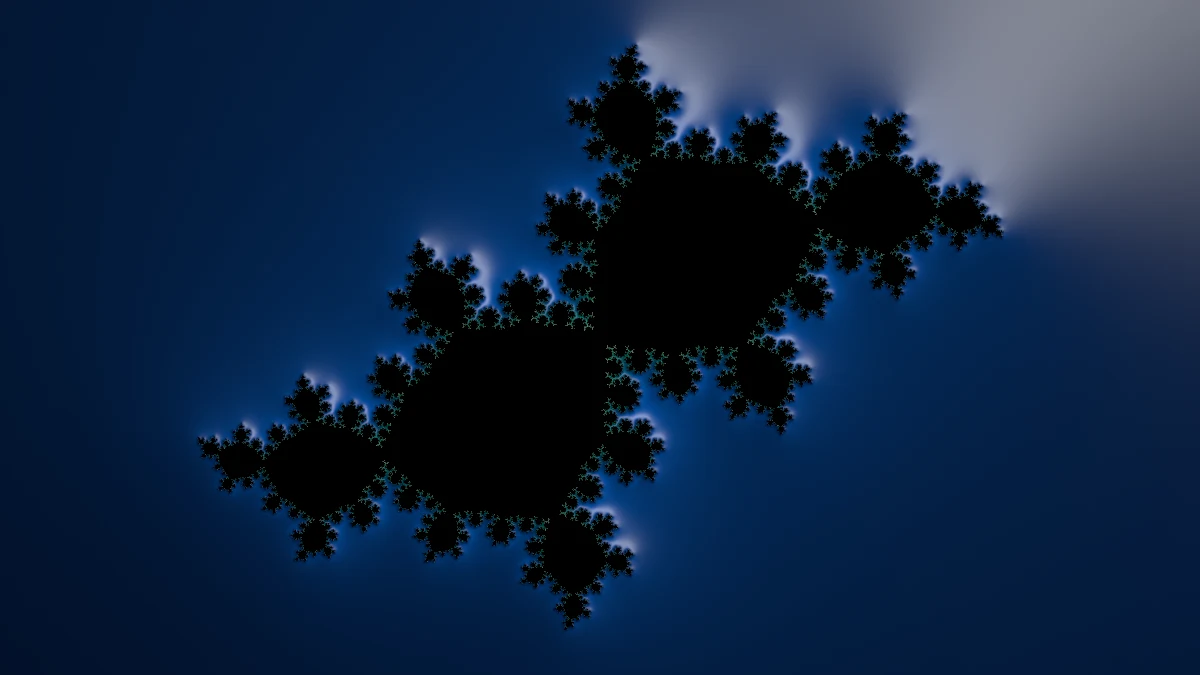
San Marco
At the main cardioid and the period-2 disc touch. The Julia set here is pinched at countless points and is nicknamed the San Marco fractal, after the Venetian basilica and square it is said to resemble.

Cantor dust
Choose outside the Mandelbrot set, for example , and the Julia set falls apart into infinitely many separate specks.

Two sides of one picture
The two kinds of picture are tightly linked. Zoom into the Mandelbrot set near a boundary point and the view comes to resemble the Julia set of that same . Tan Lei proved this in 1990 for Misiurewicz points. That is why a Julia set is a good preview of what lies under your pointer.
In the explorer
Try this: on any Mandelbrot-type fractal, hover over a point to see its Julia set in a small picture-in-picture window, and press J to open it full size. Turn on Julia mode in the side panel to type your own Re c and Im c.
Burning Ship, Tricorn, Celtic and Buffalo all have Julia versions too. Start with the Burning Ship, or go back to the Mandelbrot set.