The Buffalo Fractal
The Buffalo is the most heavily folded member of the Mandelbrot family: absolute values before squaring, and more folds after it.
The rule
The Buffalo fractal is the most heavily folded of the family. It folds before squaring, like the Burning Ship, and then folds after squaring too: the real part is made positive, and the imaginary part is made negative.
Plain text: z → |Re w| − i|Im w| + c, where w = (|Re z| + i|Im z|)²
In real coordinates, with and , this simplifies nicely:
Plain text: x' = |x² − y²| + a, y' = −2|x||y| + b
Compared with the Mandelbrot rule, both the real and imaginary updates are wrapped in absolute values, and the imaginary step runs in the opposite direction. In other words, the Buffalo combines the Burning Ship's folds with the Celtic fold, and also forces the imaginary part to be negative.
Where it comes from
As with the Celtic fractal, there is no single founding paper to point to. The Buffalo is one of the absolute-value variants of the Mandelbrot formula that grew up in the fractal-art community, and the name is a nickname from the look of the picture. Like the other folded sets it is not an analytic map, so it is explored by experiment rather than through the classical theory of the Mandelbrot set.
What to look for
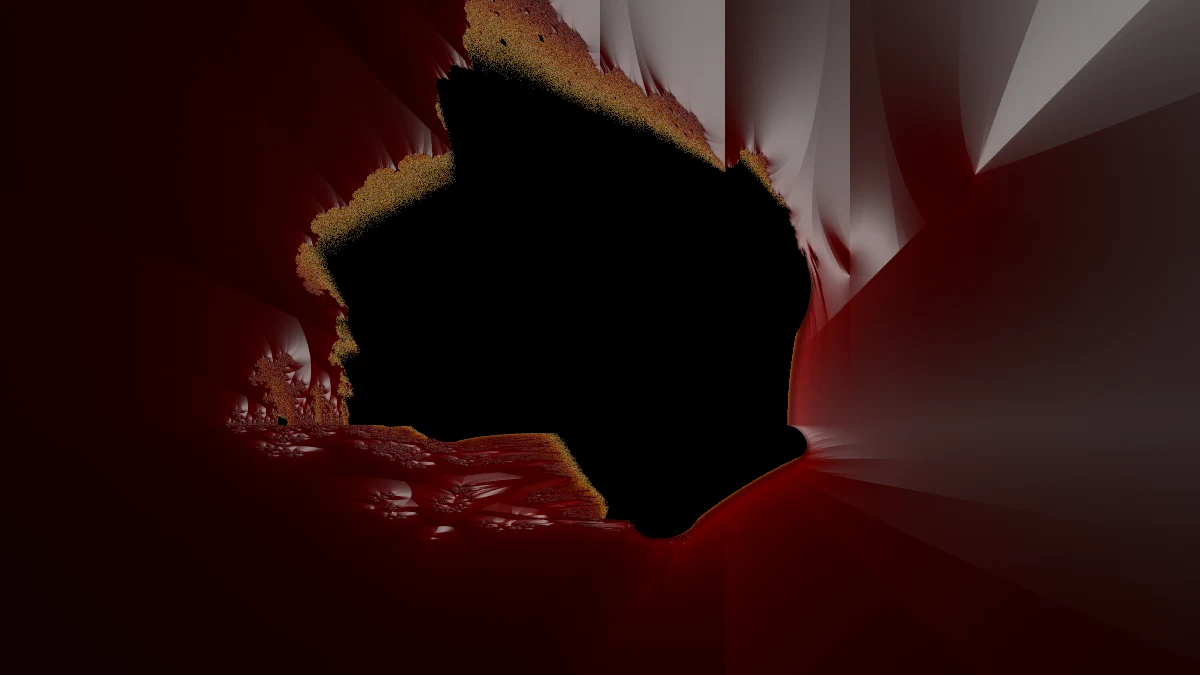
- A lopsided shape. With the imaginary part forced to run in one direction, the picture has no mirror symmetry about the real axis and sits off-center, which is why the explorer's home view is centered a little above the axis.
- The real axis. For real and real , the folds do nothing before squaring and the squared value is positive, so along the real axis the Buffalo and Mandelbrot sets agree.
- Sharp creases. Folds create edges rather than smooth curves. Around the main body, the colored bands break into fans with straight edges. Relief shading lights these creases like a landscape; flat shading shows the pure color pattern.
- Ragged edges. The boundary of the black body is far rougher than the Mandelbrot set's: zoom in on any stretch of it and the roughness continues at every scale, with small copies of the whole shape hidden in it.
Buffalo Julia sets
Fix and vary the starting point to get a Buffalo Julia set. This one uses .

Making your own discoveries
These sets have been explored far less than the Mandelbrot set, so there is plenty of room for personal discovery. A few ideas:
- Drag slowly along the boundary and watch the Julia preview in the corner for changes in shape.
- Try Export PNG at 2x or 4x for a large image of anything you find. Copy the link first so you can return to the exact spot.
- Change the palette: ocean, aurora or spectrum.
In the explorer
Try this: press H to hide all the interface, then F for fullscreen, for a clean view of the folds. Press H again to bring the controls back.
Next, a very different kind of fractal, built from triangles rather than iteration of numbers: the Sierpiński triangle.