The Celtic Fractal
Square the number, then fold its real part to the positive side. The result is an arrowhead-shaped fractal that is symmetric top to bottom.
The rule
The Celtic fractal folds the plane after squaring instead of before. Square as usual, then take the absolute value of the real part only and leave the imaginary part alone, then add .
Plain text: z → |Re(z²)| + i·Im(z²) + c
In real coordinates, with and :
Plain text: x' = |x² − y²| + a, y' = 2xy + b
Compared with the Mandelbrot rule the only change is the pair of bars around . That fold reflects everything that lands on the left side of the plane onto the right side, so after each step the new real part is never less than .
Where it comes from
This one has no single founding paper that we can point to. It belongs to a family of absolute-value variants of the Mandelbrot rule that grew up in the fractal-art community alongside the Burning Ship. The name is a nickname from that community. Because the fold is not an analytic map, the classical theory of Douady and Hubbard does not apply directly, and the set is mostly explored by looking.
What to look for
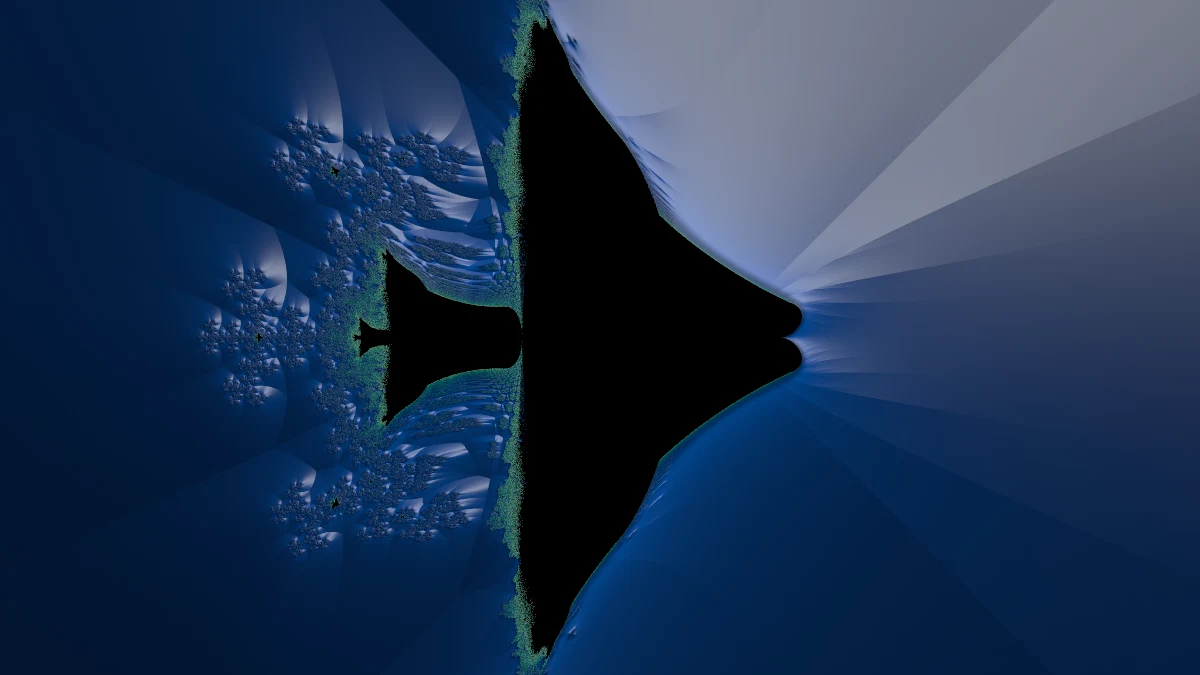
- An arrowhead, not a heart. The Mandelbrot cardioid has a smooth round outline. Here the main body is an arrowhead pointing right with a flat left side, and a smaller bell-shaped region sits further left.
- Tree-like clusters. To the left of the flat edge, look for clusters of tiny copies that branch like little trees. Filaments shading traces their thin outlines.
- Straight-edged fans. On the right the colored bands break into fans with straight edges, a visible effect of the fold.
- A mirror line. The picture is symmetric about the real axis: conjugating and together leaves the rule unchanged.
- The real axis. For real numbers is never negative, so the fold does nothing and the Celtic fractal crosses the real axis exactly where the Mandelbrot set does, between and .
- Different powers. The explorer applies the same fold after the power for any exponent from 1.5 to 12. Set it in the Shape section of the panel, for instance power 3.
Celtic Julia sets
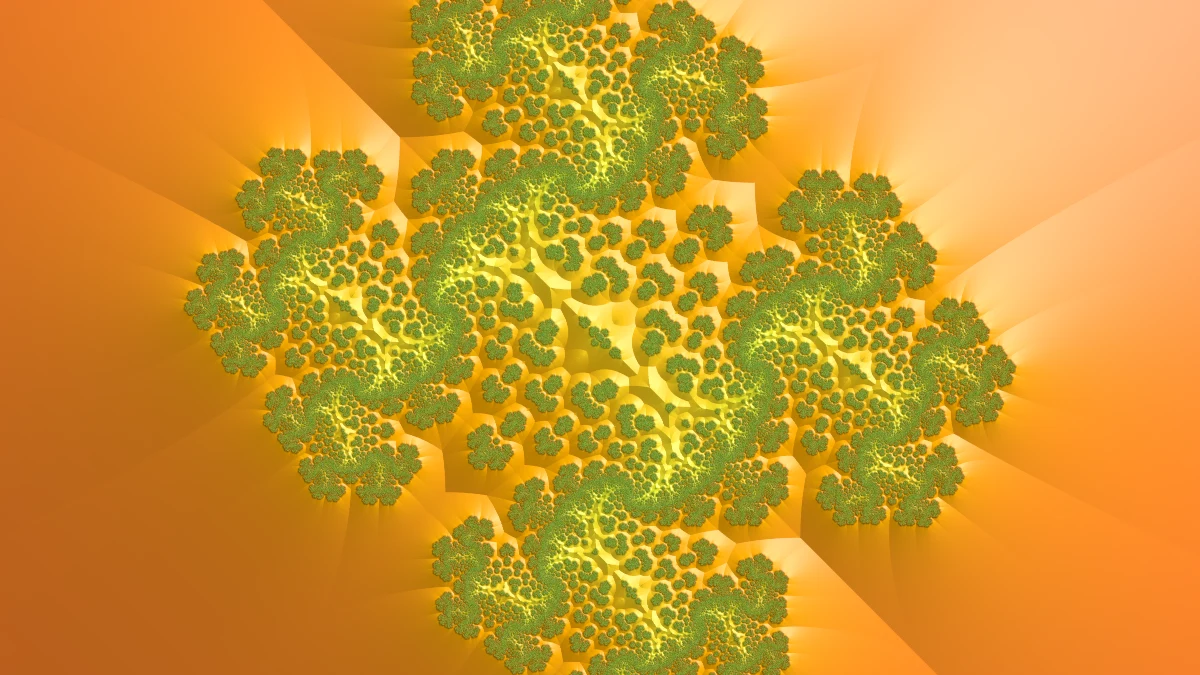
Fix and vary the starting point, and the same rule gives a Celtic Julia set. Here is one for .
A quick experiment
Open the home view and drag the pointer slowly from the arrowhead across to the bell-shaped region, watching the Julia preview in the corner. The previews change character as you cross between the two. Then switch Shading between Flat, Filaments and Relief to see how the same boundary looks lit and unlit.
Seeing the family resemblance
The five Mandelbrot-style fractals in the explorer are one idea with different folds. Open the Mandelbrot set, the Burning Ship, the Tricorn and the Buffalo in turn and compare how each one treats the same stretch of real axis. The one-formula table shows exactly where each fold goes.
In the explorer
Try this: hover over a point and press J to open the Celtic Julia set for it. Then press C to start color cycling: the shifting colors make the folded structure easy to follow with your eye.